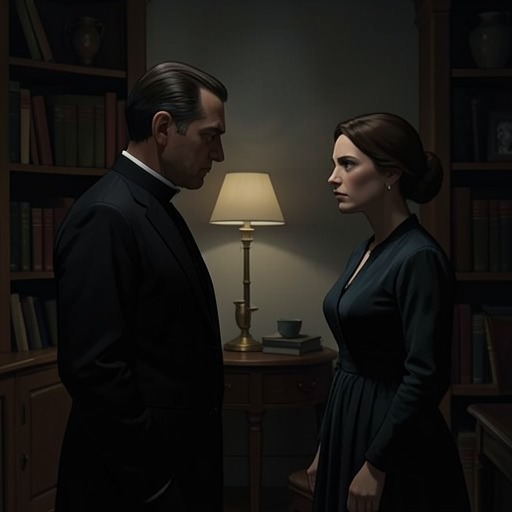
Seal of the Confessional
The Pale HorseThe Seal of the Confessional is a question of secrecy that shapes Inspector Lejeune’s early reconstruction of Father Gorman’s murder. The investigation does not establish that Mrs Davis’s disclosure was made under the seal, or settle what the priest was told. Its importance lies in the uncertainty: the possibility of confidential confession makes the names Father Gorman wrote down harder to interpret, while Lejeune’s alternative hypothesis of blackmail gives the inquiry a practical direction.
The Question of Secrecy
Inspector Lejeune considers whether Mrs Davis told Father Gorman something as she was dying, and whether he hurried to record a list of names before he forgot them. The uncertainty is essential. The scene presents this as a question about what the priest might have done if the information had been given under the Seal of the Confessional, not as proof that it was. The distinction keeps a possible religious obligation from being mistaken for a confirmed circumstance of the case.
Lejeune’s response is cautious rather than doctrinal: the disclosure need not have been made under a seal of secrecy. That qualification leaves more than one possible explanation for Father Gorman’s list. He may have received information in a confidential religious encounter, but the evidence available in this exchange does not establish that; nor does it explain the precise boundaries or operation of the seal. In the investigation, the rule functions as a constraint on inference. The names suggest that something was entrusted to the priest, but the circumstances of that trust remain unknown.
Blackmail as a Working Hypothesis
To explain why the names might matter, Lejeune proposes that they could be connected with blackmail. He imagines that the people on the list were being blackmailed, and that Mrs Davis was either the blackmailer or someone who knew about the scheme. In his account, repentance and confession might have led her to make reparation as far as possible, with Father Gorman assuming responsibility for what she had revealed.
Lejeune explicitly marks this account as a working hypothesis, not a solved explanation. He has no settled idea yet, and he stresses that everything beyond the basic possibility is conjectural. His proposed sequence is conditional: if blackmail had become a profitable racket, someone might have wanted it to continue; if that person knew Mrs Davis was dying and had sent for a priest, the visit could have threatened the racket. The theory makes the list, the deathbed encounter, and the priest’s killing parts of one possible chain, but it does not convert any link into established fact.
The seal therefore sharpens the problem rather than resolving it. If the names came from a confession protected by secrecy, Father Gorman’s act of writing them down needs particular explanation. If they were communicated outside that protection, the same list could instead point more directly to a blackmail scheme. Lejeune keeps both possibilities open while using the latter to ask who might have had a reason to prevent the information from coming to light.
The Deathbed Clue
A witness who had left Mrs Davis and Father Gorman together cannot precisely remember their conversation. The witness recalls speaking to Mrs Davis to cheer her, then remembers hearing her mention wickedness as the door was being closed. The witness also recalls a reference to a horse, perhaps horse racing, and associates racing with crookedness. The recollection is hesitant, and the connection to blackmail is not supplied by the witness; it emerges as a possibility in the investigators’ interpretation.
The remembered words give Lejeune a new reason to look closely at the visit. He is struck by the reference to wickedness, while the witness assumes that Mrs Davis was confessing sins before death. The mention of a horse is less definite: the witness wonders whether it concerned horse racing and crooked dealings there. Neither recollection identifies a culprit or proves that the names concerned blackmail. Together, however, they make the deathbed conversation seem potentially more specific than a general confession, and raise the possibility that Father Gorman learned something dangerous.
Significance in the Inquiry
The Seal of the Confessional marks the boundary between what the investigators can infer and what they can demonstrate. Mrs Davis’s dying disclosure, Father Gorman’s written names, the remembered words about wickedness and a horse, and the murder may be connected, but the evidence in this episode does not prove how. Lejeune’s method is to preserve that gap: he distinguishes the witness’s imperfect memory from his own theory and labels the theory conjectural.
That restraint also gives the clue its suspense. The priest’s visit can be understood as a private religious act, a channel through which a possible blackmail victim tried to make reparation, or both; the inquiry cannot yet tell which account is accurate. Lejeune’s suggestion that someone wanted a paying racket to continue offers a motive for silencing Father Gorman, but remains conditional. At this stage, the seal is not a final answer about what was disclosed. It is the unresolved condition against which the list, the witness’s recollection, and the priest’s murder must be read.